
In any solar-plus-storage system, the battery is one of the larger cost items. That is why the battery storage cost trend matters so much to anyone buying, renting, or building containerized power. The latest annual price survey, published in December 2025, shows prices at another record low, with stationary storage now the cheapest lithium-ion segment of all.
Prices hit a new low
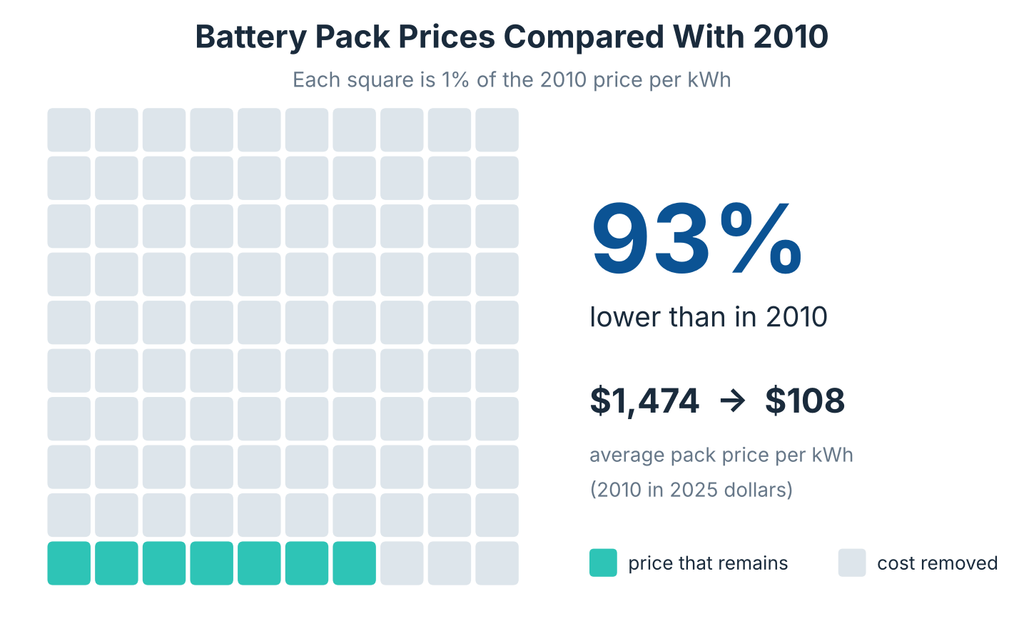
Lithium-ion battery pack prices fell 8% in 2025 to a global average of $108 per kWh, the lowest figure ever recorded. That is 93% below the 2010 level, which works out to roughly $1,474 per kWh in today’s money. The drop came even though prices for battery metals such as lithium and cobalt rose during the year.
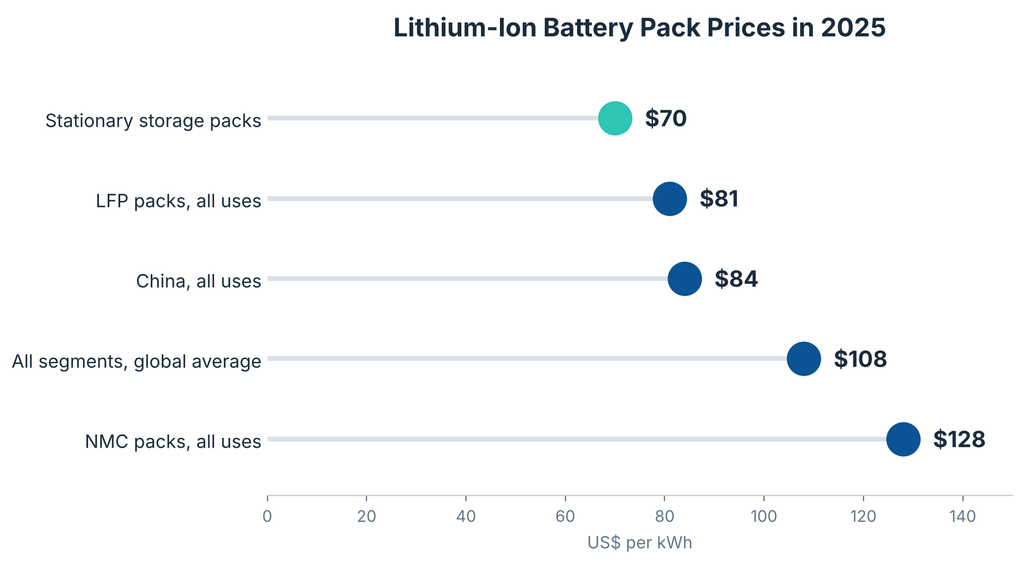
The biggest story sits inside stationary storage. Pack prices for stationary systems averaged just $70 per kWh in 2025, a 45% fall in a single year. For the first time, stationary storage became the lowest-priced battery segment, ahead of electric vehicles. Three forces explain the shift:
- Overcapacity. Cell manufacturers have built more capacity than the market currently needs, which keeps competition intense.
- Chemistry. Stationary storage has almost fully moved to lithium iron phosphate (LFP), and LFP packs averaged $81 per kWh compared with $128 for nickel manganese cobalt (NMC).
- Competition. Many suppliers can now serve the same projects, so buyers have real choice on price.
At the very bottom of the market, the lowest stationary LFP packs observed in the survey cost as little as $50 per kWh.
Not every region pays the same
The global average hides large regional gaps. Packs in China averaged $84 per kWh, while pack prices in North America and Europe were 44% and 56% higher, reflecting higher local production costs and greater reliance on imported batteries. Prices did fall in all three regions, by 13% in China, 8% in Europe, and 4% in North America, but the gap remains.
For European buyers, the practical lesson is that the headline price per kWh is only a starting point. The total delivered cost of a storage container also depends on freight, certification, and local installation.
Deployment is following the price
Falling prices are showing up in installations. Global battery storage additions reached a record 108 GW in 2025, up around 40% on the year before, and costs that have fallen by more than 90% since 2010 are a key reason. Utility-scale projects made up about 87 GW of that total, but the growth is broadening. Australia added nearly 8 GW, almost nine times the previous year’s figure, and newly installed capacity across the Middle East reached about 3 GW, three times the 2024 level.
What this means for containerized and foldable solar
Cheaper batteries change the economics of containerized power in several practical ways:
- More storage per budget. A lower cost per kWh makes it realistic to specify larger battery capacity, which lets a site cover evening and overnight loads and cut generator running hours further.
- The rest of the system matters more. As the battery becomes a smaller share of total cost, the container structure, power electronics, transport, and installation make up a bigger share. That puts a premium on designs that are easy to ship and quick to commission, such as foldable containers that travel compact and open into full size on site.
- Wider markets open up. Projects that did not pencil out at higher battery prices, such as remote sites, temporary works, and smaller island systems, can become viable.
There is one caution. Analysts note that if battery metal prices stay elevated, the effect could eventually show up in cell and pack prices, so the current low should not be treated as guaranteed to last.
Looking ahead
The direction is clear even if the pace slows: battery storage cost has fallen by more than 90% in 15 years, and stationary storage is now the cheapest place to buy lithium-ion capacity. For buyers of solar storage containers, that means more capacity, more flexibility, and a wider range of use cases than a few years ago, with the real differences between suppliers increasingly found in design, logistics, and reliability rather than the battery price alone.
 English
 Croatian
 Czech
 Danish
 Dutch
 Estonian
 Finnish
 French
 German
 Greek
 Hungarian
 Irish
 Italian
 Japanese
 Korean
 Lithuanian
 Luxembourgish
 Norwegian
 Polish
 Portuguese
 Romanian
 Slovak
 Slovenian
 Spanish
 Swedish