
When a hurricane knocks out the grid, the question is never whether power will come back. It is how many days, or weeks, people will wait for it. That waiting period is exactly what a new generation of containerized solar-plus-storage systems is designed to shrink, and recent field data from the Caribbean shows why utilities, disaster-response agencies, and energy planners are paying closer attention.
A resilience tool built for speed
Traditional grid repair after a major storm often means waiting for replacement poles, transformers, and long transmission runs to be rebuilt, a process that can stretch on for weeks in remote or island regions. Containerized solar microgrids skip most of that timeline. Because the solar array, battery bank, inverters, and controls all ship as one pre-integrated unit, these systems can be transported by truck, ferry, or even air, and brought online in a matter of days rather than weeks.
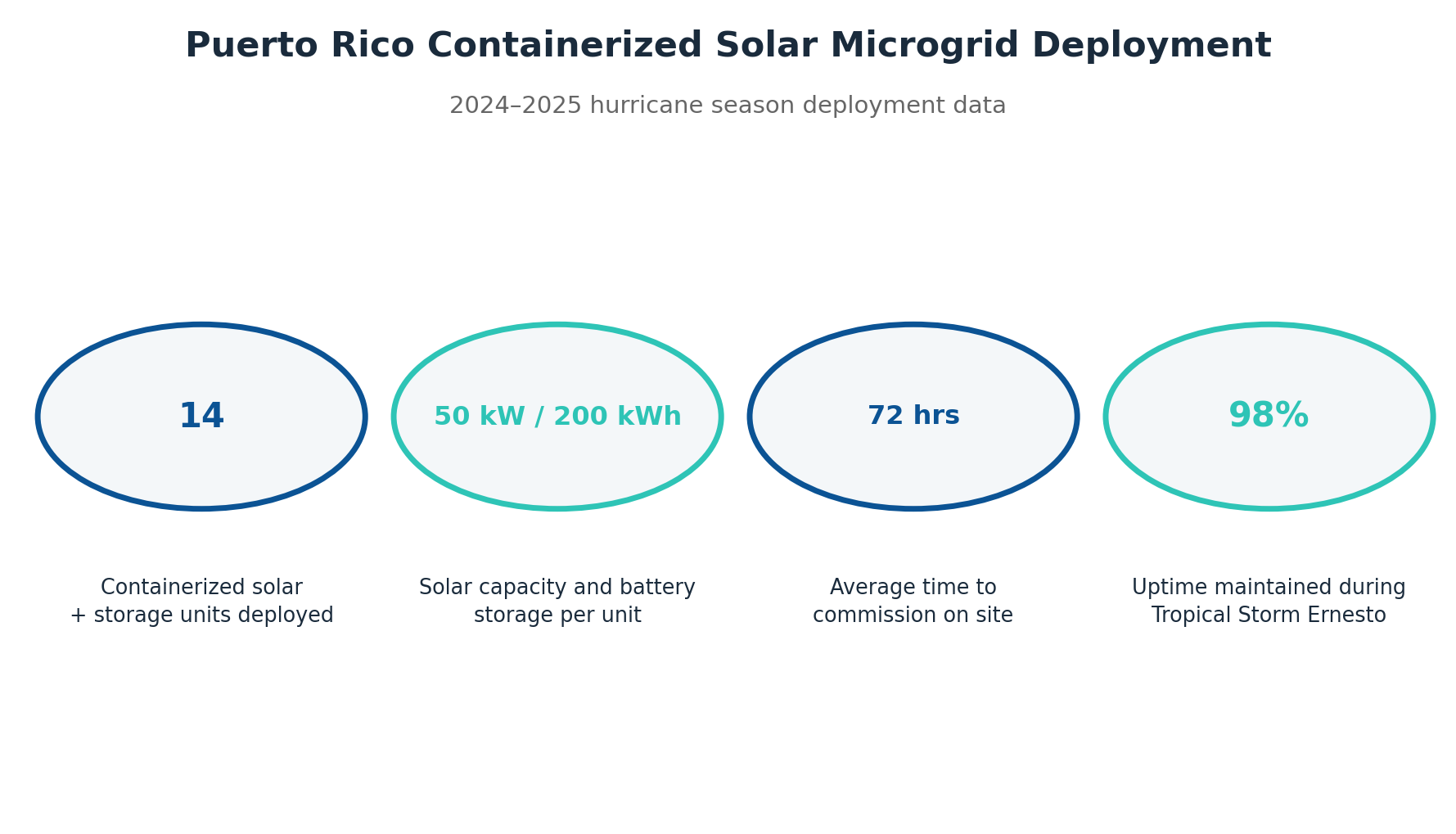
Field results back this up. During the 2024-2025 hurricane season, 14 containerized solar-plus-storage units were deployed across Puerto Rico, each rated at 50 kW of solar generation paired with 200 kWh of battery storage. According to industry analysis from Mordor Intelligence, these units were commissioned within roughly 72 hours of arrival and maintained 98% uptime through Tropical Storm Ernesto, a period when large sections of the conventional grid were still down. In the same event, a separate microgrid built from rooftop arrays and battery banks kept a 1.2 MW community system online, reinforcing the same lesson: distributed, containerized power holds up when centralized infrastructure does not.
Why the economics are shifting in this direction
Part of the reason containerized solar microgrids are gaining ground is simple math. Diesel remains the default backup fuel in many disaster zones, but delivered diesel in these situations often costs between 1.20 and 1.80 USD per liter, and supply frequently arrives late when roads or ports are damaged. A pre-fueled, self-contained solar and battery system removes that logistics bottleneck entirely once it is on site.
Funding is following the same logic. In 2024, the U.S. Federal Emergency Management Agency directed 428 million USD in Hazard Mitigation Grant funding specifically toward islanded energy projects, recognizing that resilient, self-sufficient power infrastructure reduces long-term disaster costs more effectively than repeated diesel logistics.
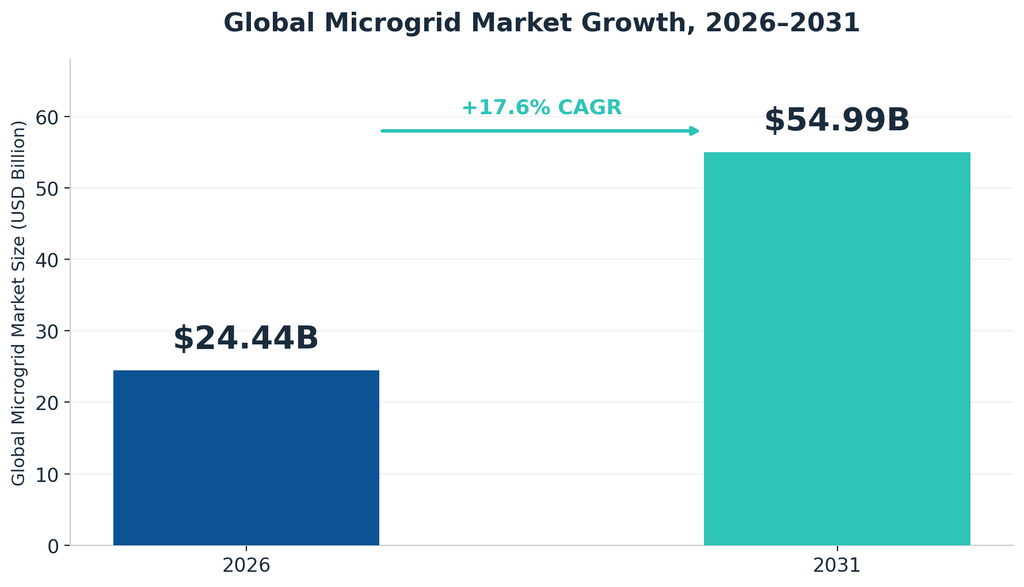
This is showing up in the broader market numbers as well. Estimates vary depending on how each research firm defines the market, whether hardware-only or full turnkey EPC scope is counted, and how software and controls revenue is treated, but the direction is consistent across sources. Mordor Intelligence puts the global microgrid market at roughly 24.4 billion USD in 2026, growing at close to an 18% compound annual rate through 2031, with off-grid and islanded deployments identified as one of the faster-growing segments. Other research houses, including Grand View Research, size the broader microgrid category even larger and project it to keep expanding at close to a 20% compound annual rate into the early 2030s. Whichever baseline is used, disaster-recovery and off-grid applications are consistently flagged as a segment growing faster than the market average.
What this means for containerized and foldable solar products
For manufacturers and buyers evaluating containerized power systems, the Puerto Rico deployments point to a few practical takeaways:
- Deployment speed matters as much as capacity. A system that arrives pre-wired and can be commissioned in days, rather than requiring extensive on-site assembly, is what actually gets used in an emergency window.
- Uptime under real storm conditions, not just rated output, is the metric that counts. The 98% figure achieved during an active tropical storm is a more meaningful benchmark than nameplate capacity alone.
- Transport and footprint efficiency are becoming differentiators. As more of these systems are shipped internationally for both disaster response and everyday off-grid use, such as remote job sites, telecom stations, and rural electrification programs, container designs that fold or collapse for shipping and expand on site are gaining attention for cutting freight volume without sacrificing the finished system’s footprint.
As grid resilience becomes a stated policy priority in more countries, from U.S. hazard mitigation funding to island-nation energy strategies, containerized and modular solar microgrids look set to move from an emergency-response niche into a standard part of grid-resilience planning.
 English
 Croatian
 Czech
Czech Danish
 Dutch
Dutch Estonian
 Finnish
 French
 German
 Greek
Greek Hungarian
 Irish
Irish Italian
 Japanese
 Korean
 Lithuanian
 Luxembourgish
 Norwegian
 Polish
 Portuguese
 Romanian
 Slovak
 Slovenian
 Spanish
 Swedish