
When people picture “off-grid solar,” the first image is usually a rural home or a village mini-grid. But the latest global data tells a broader story: off-grid renewable power is increasingly about keeping remote worksites, farms, telecom towers, and event locations running, not just lighting homes. That shift matters directly for anyone evaluating containerized or foldable solar power systems.
The scale of off-grid growth
According to the International Renewable Energy Agency, global off-grid renewable power capacity reached 11.1 GW by the end of 2024, enough to connect 86 million people to electricity for the first time. Africa accounted for more than three-quarters of that year’s new beneficiaries, reflecting continued momentum in rural electrification across the continent.
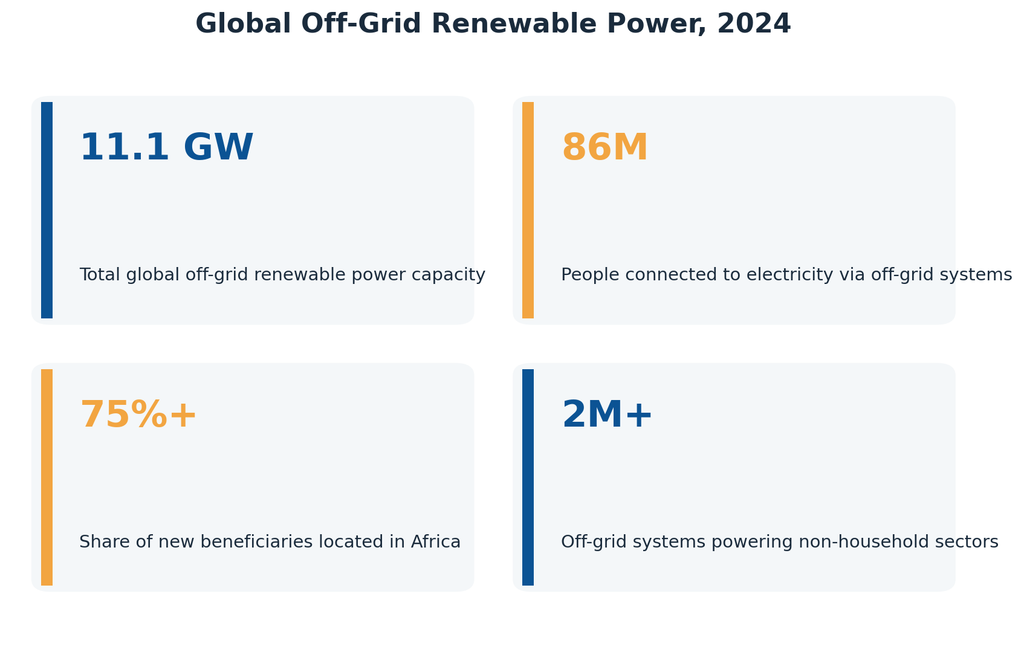
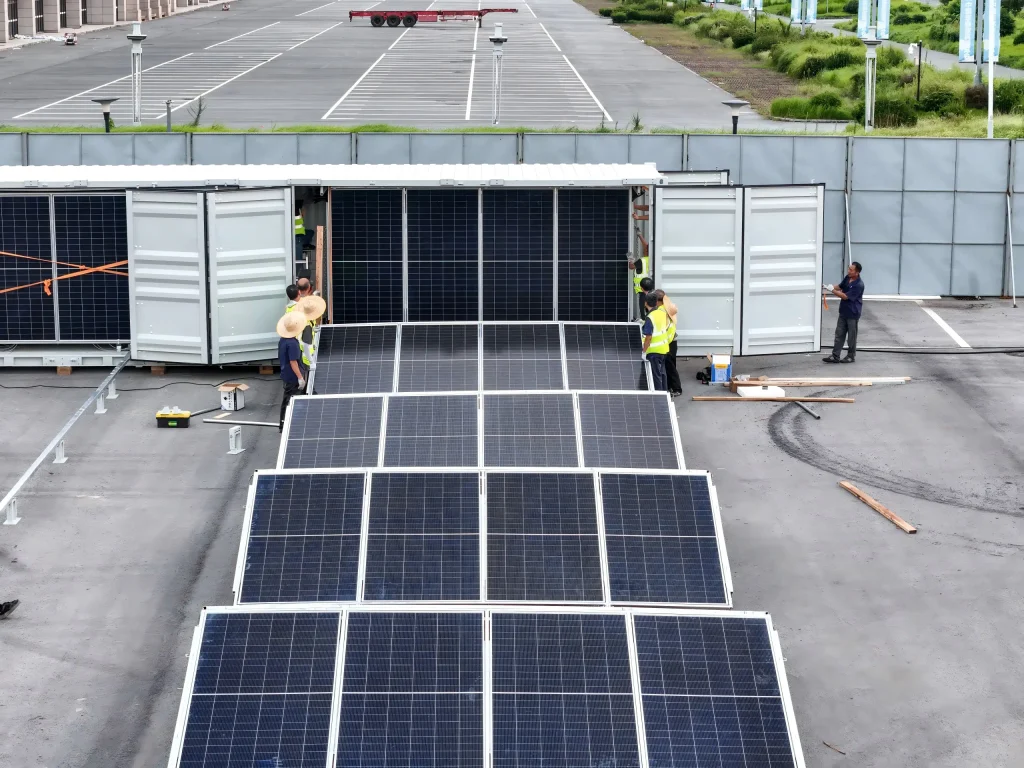
What’s easy to miss in the headline number is the non-household share of that market. Over 2 million off-grid renewable systems worldwide are now delivering power to sectors that have nothing to do with residential lighting: agriculture, healthcare facilities, schools, public lighting, tourism operations, and communications infrastructure. This is exactly the segment that containerized and foldable solar-plus-storage products are built to serve, since these are precisely the site types, remote, temporary, or infrastructure-light, where a pre-integrated power system beats building fixed grid connections.
The growth rate is accelerating, not plateauing
The 2024 snapshot also fits inside a longer growth curve. Separate IRENA capacity statistics, tracking off-grid electricity across regions outside Europe, North America, and Eurasia, show total capacity rising from 12.7 GW in 2023 to 14.3 GW in 2024. More notably, the amount of new capacity added in a single year nearly tripled compared to the prior year’s pace.
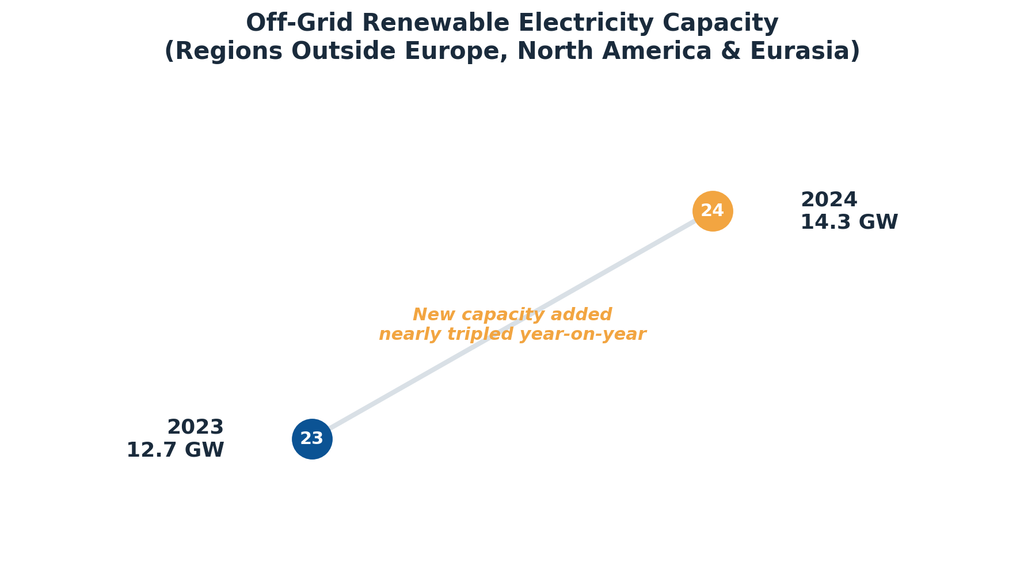
That acceleration lines up with a wider trend across the renewable sector: 2024 saw a record 585 GW of new renewable capacity added worldwide, a 15.1% annual growth rate, the fastest on record. Off-grid deployment is riding the same wave, just applied to sites that will likely never see a conventional grid connection, or that only need power for a defined project window.
What this means outside the traditional “energy access” story
For markets like Europe, the off-grid growth story looks a little different than it does in Sub-Saharan Africa. It is less about first-time electrification and more about:
- Temporary and remote industrial power – construction sites, agricultural operations, and infrastructure projects that need power before permanent grid connections exist, or in locations where one is never planned.
- Grid resilience and backup – sites in areas prone to grid instability or extreme weather, where a self-contained solar-plus-storage unit can operate independently when the main grid is down.
- Mobile and event-driven demand – festivals, exhibitions, film productions, and disaster-response operations that need clean, quiet power for a limited period and then need to relocate the equipment elsewhere.
These use cases share a common requirement: the power system has to arrive ready to run, without months of site engineering. That is the core design premise behind containerized solar products, and it is increasingly why foldable formats are gaining attention specifically, a folding structure that ships flat-packed cuts freight volume and cost compared to a rigid container shell, while still unfolding into the same footprint on site.
The takeaway
The off-grid renewable sector isn’t a niche adjacent to the main grid story anymore, it is one of the faster-growing corners of the broader renewable buildout, and a meaningful share of that growth is commercial and industrial rather than residential. As more governments and private operators treat resilient, deployable power as standard infrastructure rather than a stopgap, containerized and foldable solar-plus-storage systems are positioned to move from a specialty tool into a mainstream category of power equipment.
 English
 Croatian
 Czech
Czech Danish
 Dutch
Dutch Estonian
 Finnish
 French
 German
 Greek
Greek Hungarian
 Irish
Irish Italian
 Japanese
 Korean
 Lithuanian
 Luxembourgish
 Norwegian
 Polish
 Portuguese
 Romanian
 Slovak
 Slovenian
 Spanish
 Swedish