
Most coverage of the EU Battery Regulation focuses on electric vehicles, and understandably so, since EV batteries were the first category subject to its rules. But the regulation covers nearly every rechargeable battery category placed on the EU market, including the large lithium battery banks integrated into containerized and foldable solar-plus-storage systems. For manufacturers and buyers in that space, the compliance clock is already running.
A single framework replacing a patchwork of national rules
Regulation (EU) 2023/1542 came into force in August 2023 and became generally applicable across the EU in February 2024, replacing the older Battery Directive. Its goal is straightforward: push batteries sold in the EU toward a lower carbon footprint, more responsibly sourced raw materials, and a higher rate of collection and recycling at end of life. Unlike the directive it replaced, it applies directly and uniformly across all member states, with CE marking against the new requirements already mandatory.
The rules do not land all at once. They are phased in across categories and years, and the schedule has already shifted once since the regulation was published.
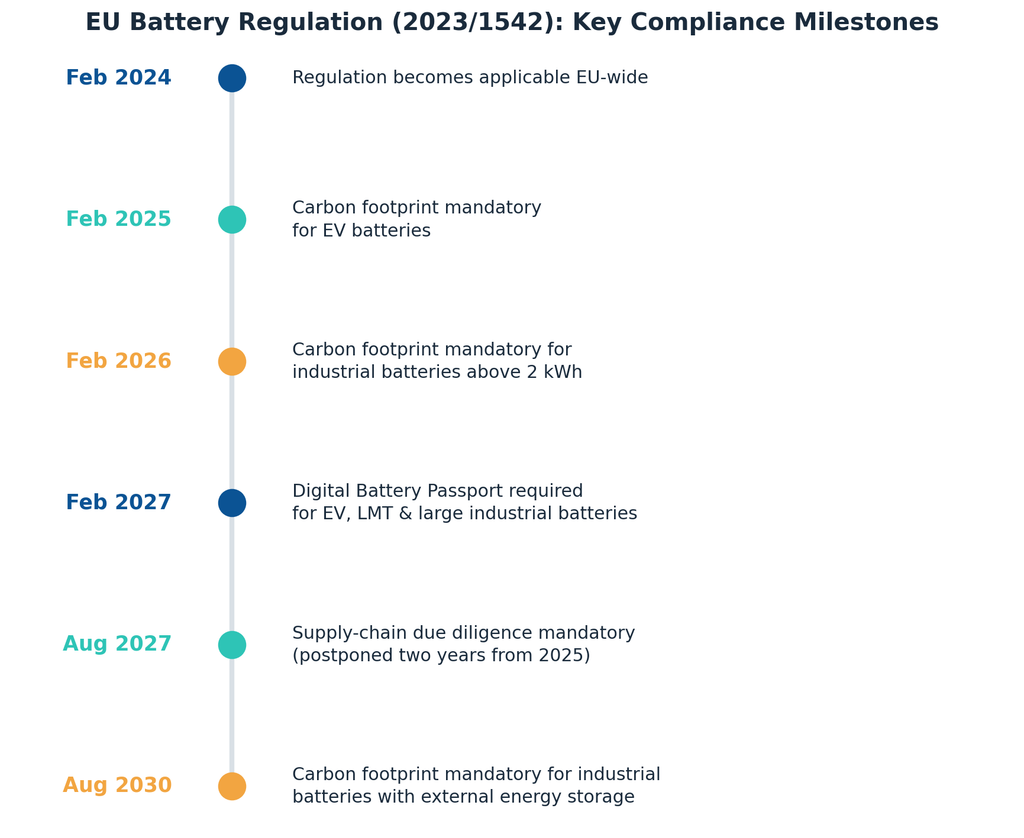
Carbon footprint declaration requirements arrived first for EV batteries in February 2025, and extended to rechargeable industrial batteries above 2 kWh, a category that covers most containerized energy storage packs, in February 2026. The Digital Battery Passport, a QR-coded record of a battery’s materials, origin, and performance data, becomes mandatory in February 2027 for EV, light-transport, and large industrial batteries. Industrial batteries used specifically with external energy storage systems, which describes many solar-plus-storage container products, face their own carbon footprint deadline in August 2030.
The rules are still moving
Supply-chain due diligence, covering responsible sourcing of cobalt, lithium, nickel, and natural graphite, was originally set to take effect in August 2025. An amending regulation, adopted in July 2025, pushed that deadline back two years to August 2027. That single change is worth noting for its own sake: this is an active, evolving compliance framework, not a fixed rulebook published once and left alone. Companies planning around any single date should expect further delegated acts and possible timeline adjustments as implementation continues.
Why this matters beyond EV manufacturers
For any company selling battery-integrated equipment into Europe, containerized solar-plus-storage systems included, the practical stakes are real. Non-compliant batteries can be blocked at the EU border, and market surveillance authorities have the power to order withdrawal or recall of products already in the market. Getting classification right matters too: a battery pack can fall into more than one category depending on how it is used, and the regulation applies whichever deadline comes earliest when that happens.
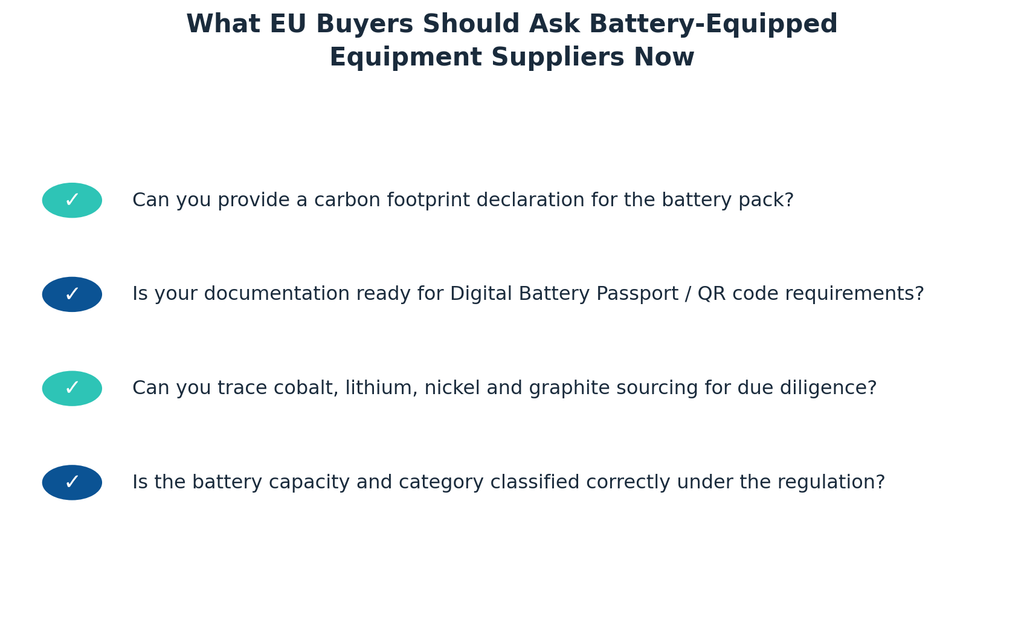
For European buyers evaluating containerized or foldable solar-storage products, this is becoming a legitimate procurement question well ahead of the hard deadlines, not something to raise only once enforcement begins. A supplier who can already produce carbon footprint data, explain their raw material sourcing, and speak to battery passport readiness is derisking a purchase in a way that price and specifications alone don’t capture.
Looking ahead
The EU Battery Regulation follows the same broader pattern seen elsewhere in European energy policy: standards that start with the most visible category, in this case EVs, and steadily widen to cover industrial and stationary storage equipment on a rolling multi-year timeline. With the next major milestone, the Digital Battery Passport, arriving in February 2027 and due diligence obligations following in August of the same year, the window for containerized solar-storage manufacturers to get ahead of these requirements, rather than scramble to meet them, is closing faster than it might appear.
 English
 Croatian
 Czech
Czech Danish
 Dutch
Dutch Estonian
 Finnish
 French
 German
 Greek
Greek Hungarian
 Irish
Irish Italian
 Japanese
 Korean
 Lithuanian
 Luxembourgish
 Norwegian
 Polish
 Portuguese
 Romanian
 Slovak
 Slovenian
 Spanish
 Swedish